
There’s a story about Sen no Rikyū, the 16th-century tea master who shaped the Japanese tea ceremony as we know it.
A wealthy student once invited Rikyū to view his tearoom. The student had spared no expense — rare scrolls hung on the walls, precious flower vases lined the alcove, and imported incense burners sat arranged on lacquered shelves. He waited proudly for his teacher’s approval.
Rikyū walked through the room in silence. Then he began removing things.
First the extra vases. Then the scrolls. Then the incense burners, one by one, until only a single flower remained in a simple bamboo container.
“Now,” Rikyū said, “there is room for tea.”
The student had confused abundance with mastery. Rikyū understood that depth comes not from accumulation, but from knowing what to keep – and what to release.
What matcha asks of us
Matcha is often surrounded by objects. Some are essential. Many are optional.
Understanding the difference allows the practice to remain simple – and sustainable.
Like Rikyū’s tearoom, a matcha practice doesn’t grow richer by adding more. It deepens by refining what remains.
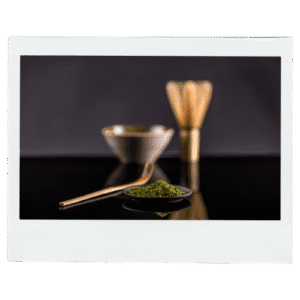
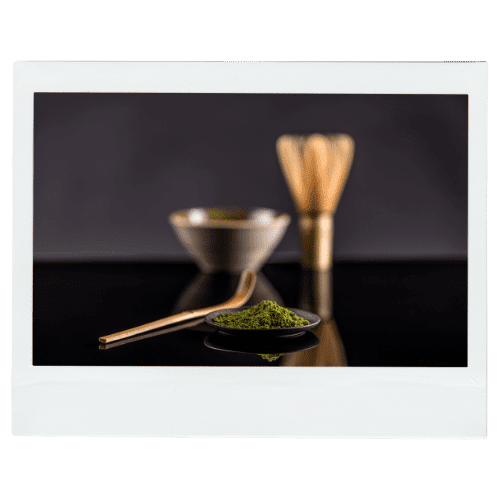
The bowl
The bowl exists to hold the moment.
It should feel stable in the hands, with enough space to whisk comfortably. Shape and texture matter more than decoration.
A bowl doesn’t need to be perfect. In fact, slight irregularities often make it easier to return to. The Japanese aesthetic of wabi-sabi teaches this – beauty exists not despite imperfection, but often because of it.
A chip on the rim. An uneven glaze. These marks become familiar landmarks, small reminders that this bowl is yours, and this moment is unrepeatable.
The whisk
The whisk introduces movement.
Traditionally made from bamboo, it’s designed to combine powder and water smoothly, creating a fine foam without force.
It’s not about speed or strength – it’s about rhythm.
A well-made whisk makes preparation feel intuitive rather than effortful. The tines flex and spring back, guiding your hand into the proper motion. Over time, the action becomes so natural you stop thinking about it — like Rikyū removing objects without hesitation, knowing exactly what belonged.
The scoop
The scoop exists to measure lightly.
Not precisely. Not obsessively.
It helps create consistency over time, allowing the body to remember rather than calculate. After enough repetitions, your hand knows the right amount before your mind does.
This is the intelligence Rikyū cultivated – not intellectual understanding, but embodied knowledge that lives in gesture and stillness.
What you don’t need
You don’t need electric frothers, thermometers, or excessive accessories.
These can be useful, but they’re not required for a meaningful practice.
Matcha doesn’t ask for optimization. It asks for attention.
When Rikyū stripped that tearoom bare, he wasn’t rejecting beauty or refinement. He was clearing space for presence – creating conditions where the student could finally stop managing objects and start experiencing tea.
The same principle applies now. Every additional tool is another thing to maintain, clean, consider, and store. Each one creates a small friction between you and the practice itself.
Fewer objects, used well
When there are fewer tools, each one carries more weight.
Preparation becomes familiar. Movements repeat. The ritual settles into place.
The right tools are the ones that disappear in use – leaving only the act itself.
Rikyū’s student learned this the hard way: that mastery looks like simplicity from the outside because complexity has been distilled down to essence. Not because nothing was learned, but because everything unnecessary was released.
Room for tea
The story doesn’t end with Rikyū removing objects.
It ends with what happened next: the student made tea, and for the first time, he was fully present for it. No arranging, no adjusting, no second-guessing his choices. Just water, powder, whisk, and bowl.
Just room for tea.
That’s what a sustainable matcha practice looks like. Not a collection of perfect objects, but a few trusted tools that help you return, again and again, to the simplest question:
Are you here?
The bowl, the whisk, and the scoop don’t answer that question. But when chosen well and used consistently, they stop getting in the way of it.
And sometimes, that’s enough.